


Once upon a time, getting your child out of their seats was the easy part. Parents were more concerned on how they could get kids to stay in them. After a lot of studies, we now know a sedentary lifestyle where individuals sit or lay down for long periods of time, is linked to increased physical and mental health risks like type 2 diabetes, heart disease, weight gain, anxiety and depression. An active lifestyle helps promote better overall health and well-being.
As parents, coaches, and teachers, the habits we help kids set up now will often carry on to the rest of their lives. That’s a lot of pressure. And beyond limiting TV time, it also starts with us.
As you’ve probably heard before: kids don’t just listen to what you say, they watch what you do.
This blog goes over what you need to know about sitting time and activity time, to help support kids develop more active lifestyles.
What everyone gets wrong with kids activity time
So first thing’s first. What does Australia say about how active kids should be for their health?
Most of us think “60 minutes a day” for kids and exercise. What the guidelines say in full is “AT LEAST 60 minutes a day of moderate to vigorous physical activity.” It’s a starting point, which makes it sound harder to achieve.
However, the national guidelines are more forgiving about how you close it than most parents assume. The Australian 24-Hour Movement Guidelines treat the whole day as one budget instead.
Age | Physical activity | Sedentary screen time | Sleep |
Under 1 | Interactive floor play, including 30 min of tummy time across the day | None | 14–17 hrs (0–3 months), 12–16 hrs (4–11 months), including naps |
1–2 years | At least 180 min of varied activity across the day | None at 1; up to 1 hr at 2 | 11–14 hrs, including naps |
3–5 years | At least 180 min, with 60 min of that being energetic play | No more than 1 hr | 10–13 hrs, including naps |
5–13 years | At least 60 min of moderate to vigorous activity daily, plus vigorous and muscle- and bone-strengthening activity on at least 3 days | No more than 2 hrs of recreational screen time | 9–11 hrs |
14–17 years | Same as above | No more than 2 hrs of recreational screen time | 8–10 hrs |
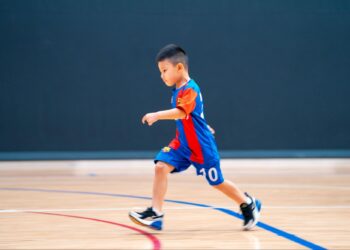
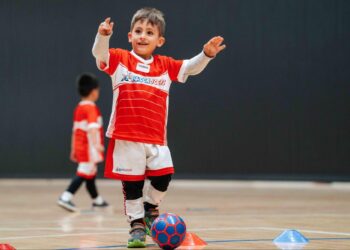
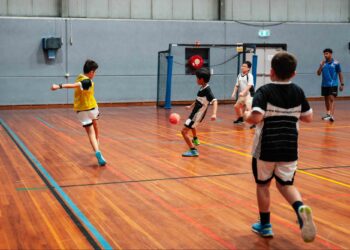
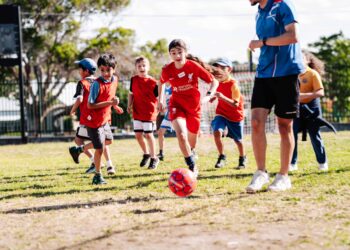
If you’re looking for 60 mins of moderate to vigorous physical activity for your child, Soccajoeys’ kids soccer program delivers. For kids aged 2.5 to 11 years old.
Also, it may be reassuring to know that the 60 minutes doesn’t have to happen in one block. That 60 minutes can accumulate across the day, and the guidelines say so outright. So you can also think of reaching it in blocks: ten minutes before school, twenty at lunch, a mad half hour before dinner, and you’re there. If that hour has been sitting on your list as a thing to find inside an already full afternoon, you can take it off.
Breaking up long stretches of sitting is a separate instruction. It sits outside the 60 minutes, gets almost no airtime, and it’s the cheaper of the two to start with.
Now the uncomfortable part
In June the Australian Bureau of Statistics published its analysis of the National Nutrition and Physical Activity Survey 2023.
Just under one in five kids is meeting the target
In the week before they were interviewed, 18.3% of Australian children aged 5 to 17 met the physical activity recommendation.
Boys and girls
22.4% of boys. 14.6% of girls.
Girls are further behind than boys. Which is worth knowing if you’ve got a daughter, because that gap doesn’t close on its own.
By age band
- 5 to 8 years: 30.8%
- 9 to 11 years: 23.0%
- 12 to 14 years: 8.2%
- 15 to 17 years: 7.6%
Worth carrying around
A further 27.7% of children did at least 60 minutes on five or six days of the week, which is a lot of households sitting just outside the line rather than nowhere near it. And average sedentary screen time for 5 to 17 year olds came in at 2 hours 51 minutes a day, against a 2 hour recommendation.
This isn’t a “kids these days” story
The 2023 figure was much the same as 19.4% back in 2011–12.
So it isn’t a recent collapse, and it isn’t about phones or this generation or anything else that makes a good headline. It’s a problem that’s been sitting quietly in the data for over a decade while everyone’s been busy.
The good news is where you’re standing
Thirty per cent at seven. Seven and a half per cent at sixteen.
If your child is five, six or seven, that’s the easiest window there is to help kids get active, and you’re in it right now.
Why sitting is its own problem
There are two costs when a kid sits for hours at a stretch.
One is the energy they didn’t burn.
The second is everything that only gets built by use: balance, coordination, spatial awareness, knowing where your body is while it’s moving fast.
You can watch the difference on a field on any given weekend. The kids who move a lot through the week aren’t necessarily the most skilful ones in the session, and quite often they’re the ones who fall over and get straight back up, because their body has had practice at falling over. Plenty of six-year-olds can’t hold a one-legged balance for two seconds, and it has nothing to do with talent.
There’s a concentration angle too, which is why so many Australian schools now build movement breaks into the timetable rather than treating them as a treat. If you’ve ever tried to get useful work out of a child who’s been seated for two hours, you already know how that goes.
The Heart Foundation frames it as two habits rather than one: move more, sit less. Both matter. The second is easier.
One thing to keep in mind as a parent, it’s not a fair fight
Parents these days are facing a harder hill to climb when it comes to getting kids active, than the parents that have come before.
In the 70s, 80s and 90s, unsupervised time to just “go play outside” was the norm. In the 2000s, as parents became more rightly aware of safety risks, it became the norm to keep kids indoors. But it’s definitely become harder to keep kids entertained indoors, without screens and with smaller spaces. It’s not just us saying it. Real Estate says in an insight report here that Australian block sizes are shrinking. That’s less floor space and less yard space to play in.
Making it harder to give and leave open spaces for kids to explore their imagination in.
Much of media today has also been designed to be so engaging that it’s addicting, which can be hard for anyone to disconnect, but especially kids. While social media has been age restricted in Australia, Youtube is still accessible (kids just can’t make a Youtube account).
Many kid shows today have been widely criticised for being highly stimulating or causing over stimulation. While these shows engage kids for hours with fast pacing, loud music, and bright flashing colours, it can make it hard for kids to pull away and even cause melt downs if you try to change the channel. Additionally, it can shorten attention spans, cause irritability and make it harder for them to focus. (When you can, look for low stimulation shows.) With all this in mind, there’s so many real contenders today for your child’s attention and time.
Read more: Healthy Alternatives for Screen Time for Children
What actually works
Before you read the list, there’s one thing you need to know, because it changes how you hear everything else.
Your kid can hit the sixty minutes and still be sitting too much.
I know, really? The Heart Foundation says it straight out. Kids who do organised sport, who do the planned exercise, the Saturday morning thing, they can tick the activity box and still spend most of the day parked. So there’s actually two jobs here. Remember: Move more. And sit less. Everyone talks about the first one. Nobody talks about the second one, and honestly? The second one’s easier.
Here’s the list. Like everything, it’s about trying things out and seeing what works and what doesn’t.
The school run and everything after it
Park five minutes away.
That’s the whole tip. The walk is the activity. But here’s the thing nobody tells you. That walk is also where the best conversation of the day happens. Because kids talk when they’re moving and nobody’s looking directly at them. The Heart Foundation actually has “go for a walk around the neighbourhood and talk about their day” on its list, and that’s exactly why.
And if the week allows it, do the whole trip. Walk it, ride it. Not every day. One morning. Right now only about a third of Aussie kids are getting to school under their own steam, so most of us have room to move on this one.
Then: ten minutes outside before anything else.
Before homework. Before the iPad. Before the negotiation about the iPad, which, let’s be honest, is the real event. Ten minutes is short enough that arguing about it costs more than just doing it.
Keep a ball in the car.
This is the hill I’ll die on. And I’m not alone, the Heart Foundation reckons a ball is often all you need. Get a cheap one. Let it get run over. Because that ball turns every ten minute wait, outside your other kid’s lesson, in a car park, at a mate’s place, into movement that nobody had to plan or book or drive to.
Oh, and this one surprised me: take them on the errands.
That’s a Heart Foundation one and I almost skipped past it. Dragging the kids to the shops, to the post office. It’s not exercise. It’s not going to burn anything. But it gets them off a screen and into a real place with actual people in it, and that counts.
Last one here. Use the extra light. Daylight saving kicks in early October for New South Wales, Victoria, South Australia, Tassie and the ACT. That’s a free hour of usable evening. Queensland, WA, Northern Territory, you’ve got your own arrangement and we respect it.
Homework and screens
Move every twenty, thirty minutes.
A lap of the yard. A glass of water from the furthest tap in the house. Ten star jumps. You’re not running a session here, you’re just breaking up the sitting, so it does not need to look like exercise. Set an alarm if you need to. I need to.
Set some active homework.
This is the Heart Foundation again, and I like it because it’s sneaky. One active job for the week, named out loud. Walk the dog twice. Ride to the shop and back. Teach your sister to skip. Giving it a name makes it a task, and a task gets done. “Go outside” doesn’t get done.
Now. Pick one screen-free evening. And make it everyone’s.
Their version is a standing screen-free day or night. Say, every Sunday. Phones off, computers off, telly off. For the whole family. And the whole family part is the bit that makes it work, because a rule that only applies to the eight-year-old is a rule you’re going to spend the entire evening in court over.
And get the devices out of the bedrooms.
It’s on their list. And the reason I love it is it’s a one-time decision instead of a nightly argument. You make it once. You’re done.
Weekends
Just pick the active version of whatever was already happening. Beach instead of shopping centre. The park with the big climbing frame instead of the one that’s closest.
And go somewhere they can hang off stuff. Monkey bars. Climbing frames. Skipping. Hopscotch. Because the guidelines ask for muscle and bone strengthening three days a week for five to seventeens, and everyone forgets it. Everyone. I think because it sounds like a gym. It’s not a gym. It’s a playground.
Then the big one. Let them be bored outside.
This is genuinely the highest-value move on the list and it asks absolutely nothing of you. Put a kid in a backyard with no plan and no equipment, and within about fifteen minutes they will have invented a sport. The rules will be terrible. Let it run.
Rain, apartments, forty degree afternoons
Not everyone’s got a backyard. And there are weeks of summer where outside just isn’t happening.
Indoor obstacle course.
Cushions, chairs, a timer. Your lounge room will not survive. Fair price.
Balloon keepy-uppy.
Slow enough to be safe inside, and weirdly exhausting. It’ll hold a five-year-old for half an hour.
Hallway soccer with a soft ball.
Which, as it happens, is roughly how a lot of professional footballers got started.
Three songs, full volume. Everybody dances.
That’s it. Put three songs on and dance. No gear, no space, no skill, no hallway. And that last one matters more than it sounds, because if you’re in a flat, everything else on this list needs floor you probably haven’t got. You can do this one in a kitchen. Works on every kid alive, and most adults, which you’ll find out about thirty seconds in.
If yours are still tiny
For the under fives it’s less about what you add and more about what you stop. The Heart Foundation says keep the time they’re strapped into a high chair, a pram, a car seat to about an hour at a stretch, and let them move freely whenever it’s safe to. Nothing to organise. Just the pram down more often.
If yours are eleven and up
Everything above this still counts. But a thirteen-year-old is not doing balloon keepy-uppy with you, and the stuff that works at this age looks different for one reason: it has to be theirs, not yours.
Hand over the errand.
Same tactic as further up the page, different mechanics. Don’t take them to the shop. Send them. Bike, scooter, on foot, with the dog. The movement is a side effect. The point is that it’s a trip they’re trusted to make alone, and at this age that’s the part that sells it.
Let them pick, even if it isn’t a sport.
Bouldering. Skate park. Dance. Martial arts. Lifting weights, which is fine for teenagers and often the first thing that makes exercise feel adult instead of childish. Running with one friend and no club attached. If the thing they choose is a thing you’d never have chosen, that’s usually a sign it’ll last.
Ask who else is going.
At eleven or twelve, the question that decides whether they turn up isn’t “is this good for me.” It’s “who else is going to be there.” Worth aiming your effort at the friend, the lift, the group chat, rather than at the activity.
Give them something physical that’s actually a job.
Mowing. Walking a neighbour’s dog for cash. Setting up and packing down at a younger sibling’s game. Teenagers who won’t do exercise will often do work, especially paid work, and it moves the same muscles.
School holidays
Holidays are where routines quietly die.
You don’t have to fill every day. Don’t try. The thing that seems to hold is one active thing a day, at roughly the same time, so the day keeps its shape. The rest can be absolute chaos.
And then there’s this one
The Heart Foundation’s list for kids finishes with a line that’s not aimed at your kids at all. It’s aimed at you. Be a role model. Limit your own time on devices.
Yeah. We opened this whole thing saying kids watch what you do.
This is where that gets expensive.
Ideas for Teachers Trying to Get More Movement in Classes
If you’re a teacher here, we know you’ve probably been in this fight for a while.
Some common tools for getting kids moving can be:
- 5 minute stretch breaks
- 2 minute breaks of other physical activities (wiggling arms and legs, jumping jacks, attempting to stand on one leg, hopping)
- Using lego, building blocks or counters as a way to complete a challenge
But it can take a bit more creative work to bring movement into the lesson activity itself, particularly when the class isn’t physical education.
Here’s some other ideas on how to get movement into an english lesson:
Before a reading, get students to assign each other roles. Then get them to read and ‘act out’ their part within a scene of a story.
Or read out a story with the class, and act out parts of the story together. Create some fun moves to get the kids to do with you, and then start asking different kids to suggest a new move for the class to try together.
Another idea for encouraging class discussion:
Ask the kids to show how much they agree or disagree with a statement, by how close they stand from the left side of the room (agree) to the right side of the room (disagree).
Or ask them to move to a corner based on their answers to a live in person quiz (option a, b, c or d).
And if you need help when it comes to PE classes, Soccajoeys also has a School Soccer Program.
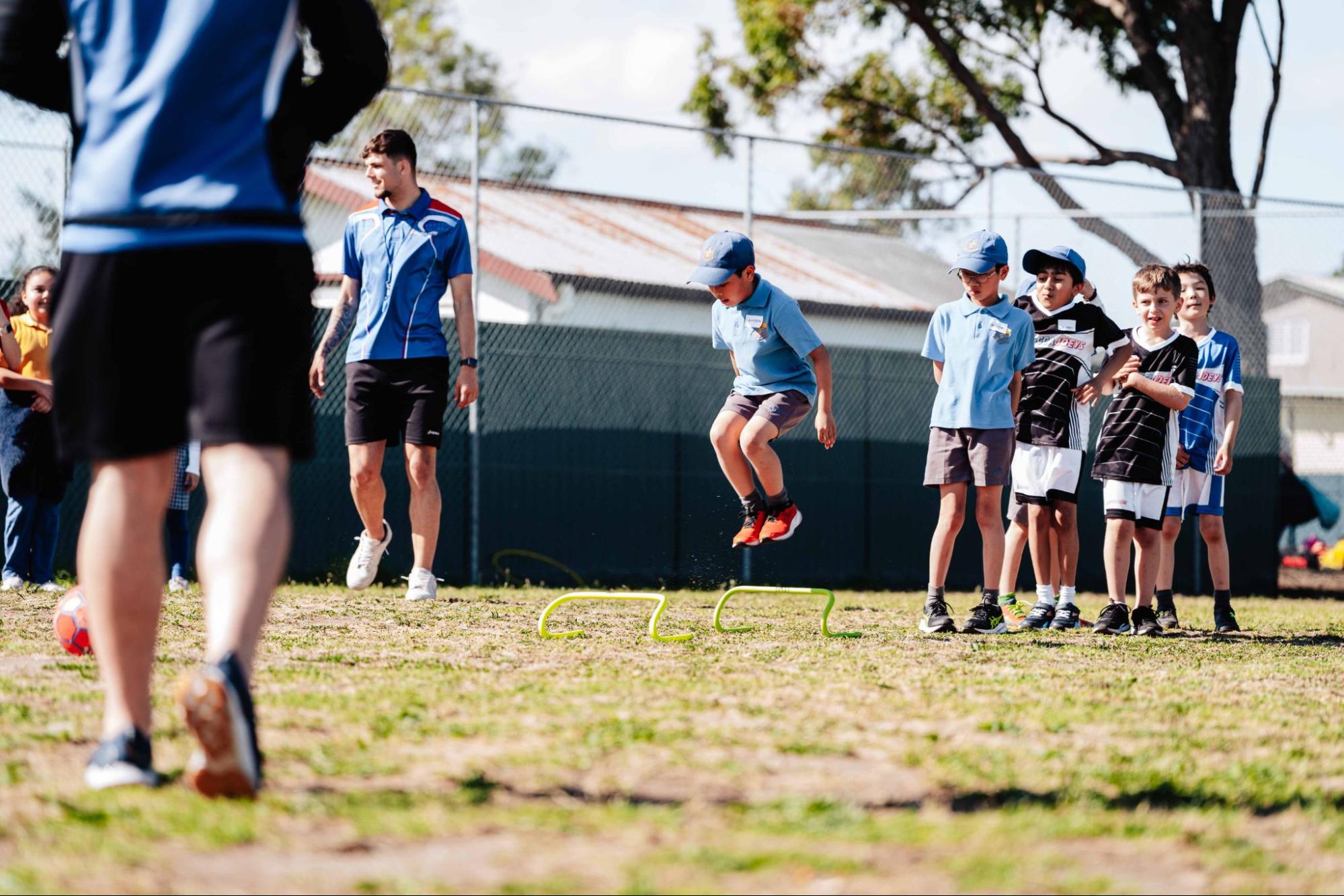
Soccajoeys runs non-competitive kids’ soccer for ages 2.5 to 11 across Australia. No scoreboard, no bench, everyone gets a turn. A weekly class won’t cover a daily target on its own, and it’s a reasonable place for a habit to start.