


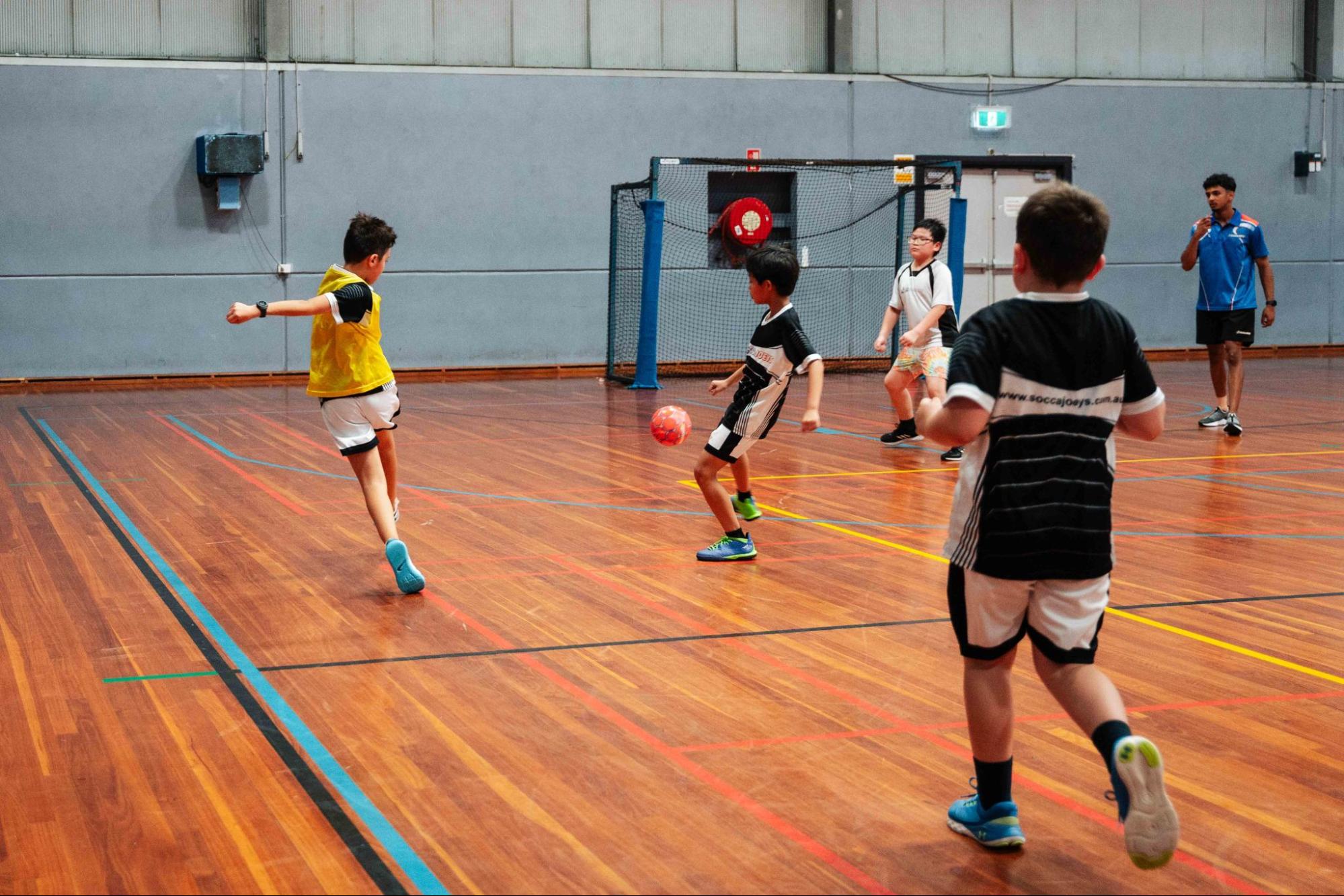
A parent-and-player guide to how long soccer games run at each junior age group in Australia, from MiniRoos through to Under 18s, plus how long Soccajoeys classes go for.
If you have ever stood on a sideline wondering whether you have time to duck to the car for a jumper, you have asked the question every football parent asks: how long is this actually going to take?
And if you are a player aged 8 to 12, you have probably asked the opposite question: why is my game so short compared to the ones on TV?
Here is the short answer, then the full breakdown by age.
Quick answer
A professional soccer match is 90 minutes, made up of two 45 minute halves plus stoppage time.
Kids’ matches are much shorter. In Australia, junior game times start at around 30 to 40 minutes total for the youngest MiniRoos (Football Australia’s official youth program for ages 4 – 11) and build up gradually to the full 90 minutes by Under 18s.
Roughly:
- Under 6 to 7: about 30 to 40 minutes
- Under 8 to 9: about 40 minutes
- Under 10 to 11: about 50 minutes
- Under 12 to 13: about 50 to 60 minutes
- Under 14 to 16: about 60 to 70 minutes
- Under 18: 90 minutes
Kids’ soccer match times by age (Australia)
Australian junior football follows Football Australia’s MiniRoos National Playing Formats and Rules up to Under 11, then moves into full field 11 a side competition from Under 12. Here is how it stacks up.
| Age group | Format | Match length | Ball size |
| U6 to U7 | 4 v 4, no goalkeeper | 2 x 15 to 20 min halves (30 to 40 min) | Size 3 |
| U8 to U9 | 7 v 7, with goalkeeper | 2 x 20 min halves (40 min) | Size 3 |
| U10 to U11 | 9 v 9, with goalkeeper | 2 x 25 min halves (50 min) | Size 4 |
| U12 | 11 v 11 | 2 x 25 to 30 min halves (50 to 60 min) | Size 4 |
| U13 to U14 | 11 v 11 | 2 x 30 min halves (60 min) | Size 4 to 5 |
| U15 to U16 | 11 v 11 | 2 x 35 min halves (70 min) | Size 5 |
| U18 | 11 v 11 | 2 x 45 min halves (90 min) | Size 5 |
Important: these are the standard formats, but state federations and local associations adjust them. Some competitions run U12 at 30 minute halves instead of 25, and some play the youngest age groups as quarters rather than halves.
Representative and NPL fixtures often run longer than local community games, as set out in the Football NSW Competition Regulations. Grading and age group placement can differ too, which Football Victoria’s MiniRoos Guidelines sets out for Victorian clubs.
Always check your club’s competition rules at the start of the season. Your team manager will have them.
Half time is short at junior level too. It is usually 2 to 5 minutes in MiniRoos, stretching to 5 to 10 minutes in older age groups. Northern NSW Football is one example of an association publishing game times and ball sizes side by side, which is handy at the start of a season.
Why do younger kids play shorter games?
It is not about going easy on them. Shorter matches are a deliberate part of how kids learn football.
Smaller games mean more touches. In a 4 v 4 MiniRoos game (Football Australia rules), every child is constantly involved. Put those same kids on a full size pitch for 90 minutes and most of them would spend the match jogging around waiting for the ball to arrive.
Attention and energy are finite. A seven year old playing a genuinely engaged 40 minutes will learn more than one who has checked out by minute 55.
Bodies are still growing. Match length scales up alongside physical development so load increases gradually rather than all at once.
The step up from 9 v 9 to 11 v 11 at Under 12 is the big one. A bigger field, more players, longer halves, and offside applying properly. It is a genuine adjustment, and it is the point where good preparation in the earlier years really shows.
For the players (8 to 12, this bit is for you)
If you are in Under 8 or Under 9, your game is 40 minutes, two halves of 20. Seven players a side, including a keeper. There is no offside rule yet, but do not just stand near their goal waiting. The Game Leader will move you.
If you are in Under 10 or Under 11, you are on a bigger field with nine a side and 25 minute halves. That is 50 minutes of football, and you will feel it in your legs.
If you have just hit Under 12, congratulations. You are on a full pitch with 11 a side and the full rules, offside included. Your match will run 50 to 60 minutes.
Here is the thing worth knowing. A professional midfielder covers around 10 to 11km in 90 minutes, but only actually touches the ball for about 90 seconds of it. Football is mostly about what you do without the ball. Which is exactly why the short, high touch games you are playing now matter so much.
How long should you plan to be at the ground?
The match length is only part of the answer for parents. Budget for the whole morning:
- Arrive 20 to 30 minutes early for warm up and the team talk
- Match: 30 to 90 minutes depending on age
- Half time: 2 to 10 minutes
- Post game: team huddle, oranges and packing up, so another 10 to 15 minutes
So a typical Under 10 Saturday is around 90 minutes to 2 hours at the ground for a 50 minute game. Bring water, sunscreen, a hat, and something warm for winter mornings.
How long are Soccajoeys programs?
This is a different question, and one we get constantly, because Soccajoeys is not competition football. It is the coaching that gets kids ready for it, and confident in it.
Weekly classes: 1 hour
Every standard Soccajoeys weekly class runs for one hour. That applies right across our programs:
- Minis for our youngest players, from 2.5 years
- Preschool for building coordination, listening and first touches
- Junior for real skills, real games and structured development
- Premier, our most advanced program, up to 11 years
One hour is deliberate. It is long enough to properly warm up, teach a skill, drill it and then play, and short enough that kids leave wanting more instead of counting down the minutes. Every session is age appropriate, so a Minis hour looks nothing like a Premier hour, even though the clock says the same thing.
School Holiday Programs: multi day camps
Our School Holiday Programs run as multi day camps, with each day’s session running in a longer block than a standard weekly class. Formats vary by location and holiday period, so check the timetable for your local venue when bookings open.
Birthday Parties: 1 hour
A Soccajoeys birthday party is one hour of action packed soccer games and activities, run by a Soccajoeys coach. You bring the cake, we bring the chaos, the organised kind.
Frequently asked questions
90 minutes, split into two 45 minute halves, plus stoppage time added by the referee. In knockout competitions, a draw can go to 30 minutes of extra time and then a penalty shootout.
90 minutes, split into two 45 minute halves, plus stoppage time added by the referee. In knockout competitions, a draw can go to 30 minutes of extra time and then a penalty shootout.
Generally no. Most junior competitions play straight time with no added minutes, as spelled out in the Manly Warringah Football Referees Association’s modified laws for junior matches. Games finish when the clock says so.
Usually 2 to 5 minutes in MiniRoos and 5 to 10 minutes from Under 12 up.
A good rule of thumb is to match training length to game length. For primary school aged players, around an hour is the sweet spot, which is exactly why Soccajoeys classes run for an hour.
No. All standard weekly classes are one hour, from Minis through to Premier. What changes is the intensity, the complexity of the skills and the amount of game play packed into that hour.
Ready to get started?
Whether your child is 2.5 and kicking their first ball, or 11 and heading into 11 a side, an hour a week with a Soccajoeys coach builds the skills, fitness and confidence that make match day fun.
Find your local Soccajoeys venue and book a free trial class.
We’ve discussed match formats and durations based on Football Australia’s MiniRoos national playing formats and typical Australian junior competition regulations. Times vary between state federations and local associations, so check with your soccer club for exact fixture details.