


You ask how their day was and you get “good.” You ask what they did at school and you get “nothing.” You have known this person since the day they were born, you live in the same house, and some weeks you could not honestly tell anyone what is going on in their head.
Then you’re out the back kicking a soccer ball for ten minutes, barely talking, and they tell you about the kid who has stopped sitting with them at lunch.
It happens too often to be luck. Your kid’s interest in sport is the easiest shared language you will ever have with them, and most of us are using about a tenth of it.
Before the list: you do not have to be good at sport for any of this. The job is watching, asking, remembering and turning up, and none of those need coordination.
Why kids talk more when you’re not looking at them
Gwyneth Doherty-Sneddon and colleagues at the University of Stirling have spent years on gaze aversion, which is what happens when someone looks away in the middle of a conversation. When children are asked questions face to face, they look away while they think, they do it more as the questions get harder, and their answers come out more accurate when they do. Later work found that making children hold eye contact produces measurable cognitive interference.
Looking away is how a child frees up the mental space to answer you. If you have spent years saying “look at me when I’m talking to you,” the research suggests that has been making it harder for them, which is a rough thing to read and rougher to recognise in yourself.
That part is tested. The next part is not, and it’s worth being clear about which is which.
Whether the same effect holds for hard feelings, whether a kid confides more easily when nobody is watching them do it, has not been studied the way the thinking has. What we have instead is that almost every parent recognises it from the car, the walk to school, the backyard, anything where you are both pointed at a third thing and neither of you has to watch the other one react. You have probably noticed it yourself, and everything below is built on that.
If your kid is under five, start here
One caveat, because it changes what you should actually do. The gaze-aversion pattern does not arrive fully formed. Adult-like patterns are established by around age eight, with a marked shift somewhere between five and six, and five-year-olds use it far less consistently. A three-year-old is not doing it at all.
So if your child is two, three or four, “they’ll open up in the car” is not true yet, and sitting there quietly will not make it true.
At that age connection runs through shared physical play and joint attention: doing the same thing at the same time, looking at the same object, being the audience for “watch me.” A three-year-old includes you. Confiding comes later, and in the meantime the chasing is the bonding, so there is nothing else you need to get out of it.
Of the five ideas below, under-fives get the most from 1, 3 and 5. Numbers 2 and 4 land once they’re at school, and they’ll keep.
1. Ten minutes of kick-to-kick after school
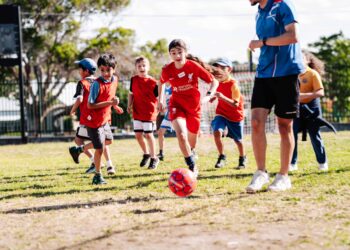
Why it works. This is the purest version of the side-by-side thing: no agenda, no scoreboard, nothing to get right. With an older kid the talking arrives as a by-product, and with a little one the playing is the entire point.
What it looks like. Before homework, before screens, before the negotiation about screens: backyard, driveway, hallway with a soft ball, or the park on the walk home. Ten minutes is the whole commitment, which is deliberately short enough that a tired parent on a bad Wednesday cannot talk themselves out of it.
What to say. Almost nothing, at first. With a school-aged kid the conversation tends to show up around minute four, and it usually arrives sideways, tacked onto something else.
What kills it. Turning it into a session. The moment you start correcting their technique it becomes training, and a child who is being assessed stops talking. I have done this and watched it happen in real time.
By age. Under five, rolling and chasing, no passing yet. Six to eight, a game with invented rules that change whenever they’re losing. Nine to eleven, properly competitive, and you will start losing for real.
It counts toward the day, too. The Australian guidelines recommend 60 minutes of activity a day for kids five and up, and they say plainly that it does not have to happen in one block.
2. Let them be the expert
Why it works. Kids spend the whole day being the person who doesn’t know. Teachers know, parents know, older kids know. Handing your child the expert role flips that, and it buys you a reason to ask endless questions about the thing they care most about.
What it looks like. “Show me how you do that.” Learn the offside rule badly and let them correct you. Ask who their favourite player is, then ask why. The why is the valuable part, because what a child admires in a player tells you more about who they’re becoming than almost anything they’ll say out loud.
What to say. “I don’t get it, explain it to me.” “What’s that one called?” “Who’s the best at that in your group?”
What kills it. Pretending. Kids detect performed enthusiasm instantly. If you don’t care about soccer, say so and care about them caring about soccer instead. They can tell the difference between those two, and they’ll forgive the first one.
By age. This one starts properly at school age. A four-year-old will demonstrate, at speed, and will teach you several things that are not true.
3. Watch a game together and let them pick the team
Why it works. Shared allegiance is one of the most durable things a family can hand around. It gives you a permanent, zero-effort topic to text about and argue about for years, well after they’ve stopped telling you things.
What it looks like. A-League and Matildas fixtures are the easy start: free to watch, close to home, and a decent chance of seeing a game live without booking a flight. Pick a club together and commit to it. Rewatch a famous goal and let them talk you through it.
Australian football handed a lot of families a shared memory this year. More than 16 million Australians watched some of the 2026 World Cup on SBS, over half the country, and plenty of parents ended up on the couch at 4am with a kid who should have been asleep. If that was your house, the door is already open. The Socceroos are back at the Asian Cup from 7 January, though those matches are on Paramount+ rather than free-to-air, so that one is for families who already have it.
What to say. Ask them to explain what just happened, even when you know exactly what just happened.
What kills it. Declaring the team yourself. Let them choose, even if they choose badly, and especially if they choose your rival.
By age. Under-fives will watch roughly eleven minutes, which is fine, because sitting next to you is the activity. Six to eleven is the sweet spot for adopting a team properly.
One note if you have a daughter. ABS data shows 14.6% of Australian girls aged 5 to 17 meet the physical activity guidelines, against 22.4% of boys. Watching women’s football together is not a small gesture.
4. Own the trip home
Why it works. For a school-aged kid, the fifteen minutes after a game is the best conversation you’ll get all week, and most of us spend it doing the one thing guaranteed to shut it down. The car is close to ideal for it: no eye contact, a fixed length, nowhere for either of you to storm off to.
What it looks like. Silence for the first few minutes, music if they want it, and no debrief.
What to say. “I loved watching you play.” “What was the best bit?” “What did you and Sam get up to?” Ask about their teammates ahead of their performance.
Those words have a history. Bruce Brown and Rob Miller, two American coaches, spent about thirty years informally asking college athletes what they most wanted to hear from a parent after a game, and “I love to watch you play” kept coming back. Asked for their worst memory of junior sport, many of them said the ride home. It was never published as a study, and thirty years of asking the same question still counts for something.
What kills it. “Why didn’t you pass?” “You should have…” “Did you win?” Warm, well-meant analysis still lands as assessment. Research on youth sport finds that a parent’s support is the biggest influence on whether a child takes up sport at all, while a child’s perception of being pressured is linked to fear of failure, anxiety, conflict at home and burnout. The line between the two sits in what they experienced, and your intentions don’t get a vote.
By age. Six and up. For under-fives, make the trip home a ritual instead, which is the last one.
5. Build one ritual and repeat it
Why it works. Rituals accumulate in a way one-off outings never do. A thing you’ve done eighty times stops being an activity and becomes part of how your kid understands your family. Family routines and rituals are associated with better child adjustment and parenting confidence, though that research shows a relationship and stops short of proving cause.
What it looks like. The same snack at the same place after every game, a song in the car on the way there, a photo in the same spot on the first day of every season, a jersey handed down.
What to say. Name it out loud. “This is our thing.” Kids need the label to know it counts.
What kills it. Making it conditional on playing well. A reward for winning is a transaction, and a ritual only works for as long as it stays unconditional.
By age. Every age, and it’s the one most likely to survive into the teenage years, when everything else here gets harder.
Start this week
Ten minutes in the backyard tomorrow, and say nothing for the first four. Find a game to watch this weekend and let them pick who you’re both supporting. Ask who the best player in their group is, then ask why.
None of it is impressive on any given day, and I’m still getting “nothing” most afternoons. The ten minutes is the part I can control, so it’s the part I do.
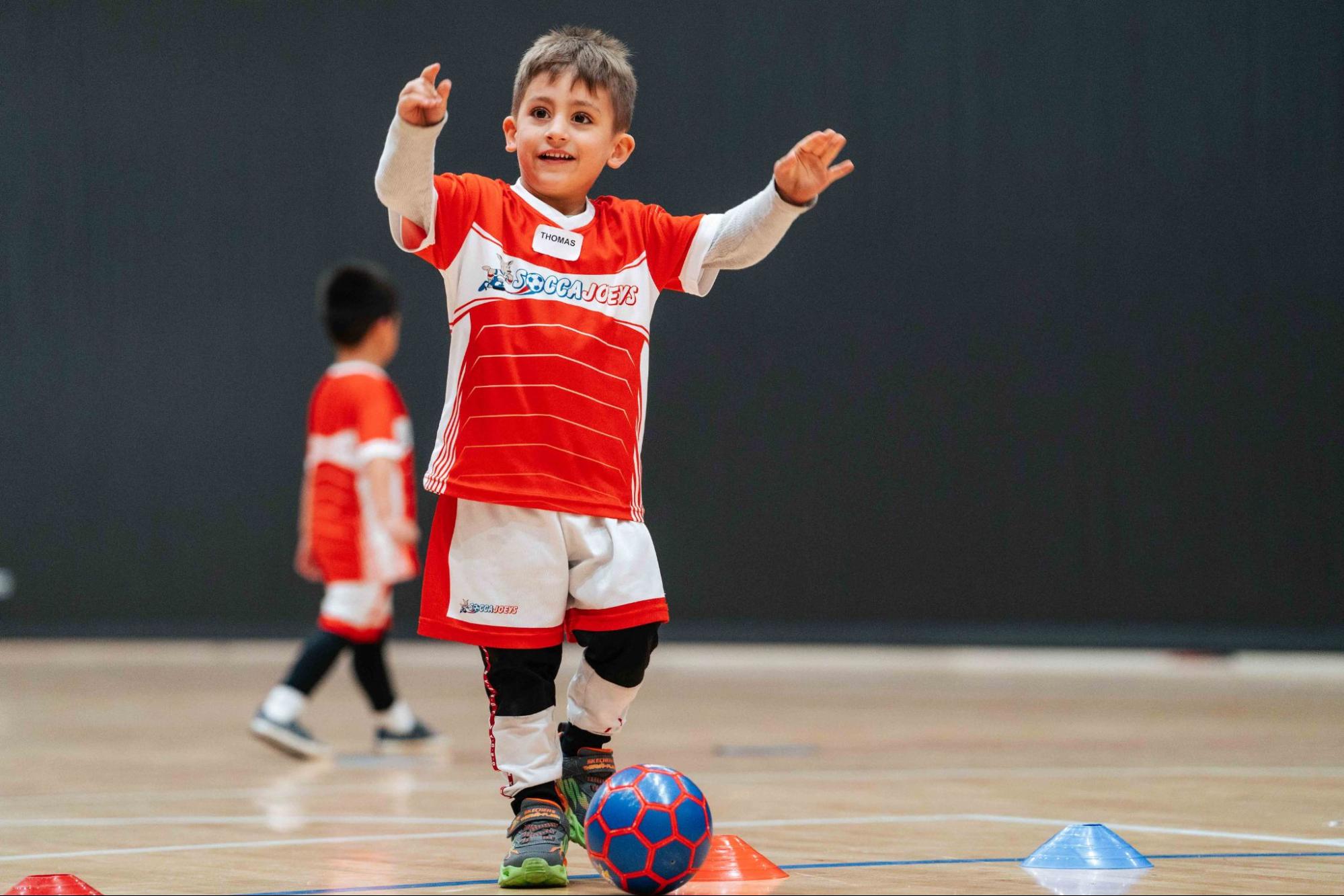
Soccajoeys runs non-competitive kids’ soccer classes for children aged 2.5 to 11 across Australia. In our Minis and Preschool programs, parents are in the session rather than watching from the fence.
Come and watch a class with your child. Find a free trial near you.