


A parent’s guide to getting your child’s first (and fifth) pair of soccer boots right.
Every season at Soccajoeys, a version of the same scene plays out in sports stores across the country. A parent stands in front of a wall of tiny, brightly coloured boots, phone in hand, trying to work out the difference between FG and AG, whether sizing up is smart or a tripping hazard, and whether their four-year-old genuinely needs moulded studs or whether the runners already in the cupboard will do.
It is more confusing than it should be. Most of what comes up when you search kids soccer boots is a shop trying to sell you one specific pair, not a straight answer about what actually matters for a growing foot.
So here is the straight answer: everything worth knowing about choosing soccer boots for kids. How they should fit, what size to buy, what all the ground-type letters mean, when to worry about studs, and how often you will realistically be doing this all again.
Do young kids even need soccer boots?
Short version: not always, and not straight away.
For toddlers and younger preschoolers just starting out, a comfortable pair of runners on grass is completely fine. At Soccajoeys, the youngest players in our Minis program (from 2.5 years) do not need boots to get everything out of a session. Flat, flexible, well-fitting shoes let little feet move naturally, which is exactly what you want at that age.
Boots start to earn their place once kids are running, turning and stopping on grass regularly, usually from around age four or five, and especially once they move into more structured games. The moulded studs on a soccer boot grip grass in a way a flat sole cannot, which means fewer slips and more confidence.
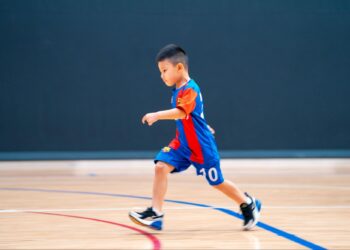
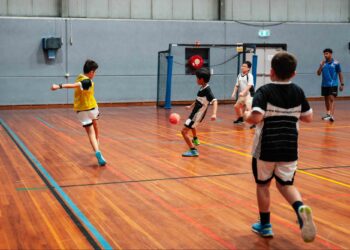
If your child plays indoors or on a futsal court, that is a different shoe again. Kids indoor soccer boots (or futsal shoes) have a flat, grippy rubber sole with no studs at all, made for hard courts. Studded boots on an indoor court are slippery and not much fun. Worth knowing if you are looking at Soccajoeys programs, since many of our classes run indoors on hard surfaces.
The rule of thumb: match the shoe to the surface, and do not rush a two-year-old into boots they do not need yet.
Getting the fit right (this matters more than the brand)
If you take one thing from this guide, make it this: fit beats brand, every single time. There is no magic label. A well-fitted cheaper boot will always do more for your child than a poorly fitted expensive one.
Here is what a good fit looks like:
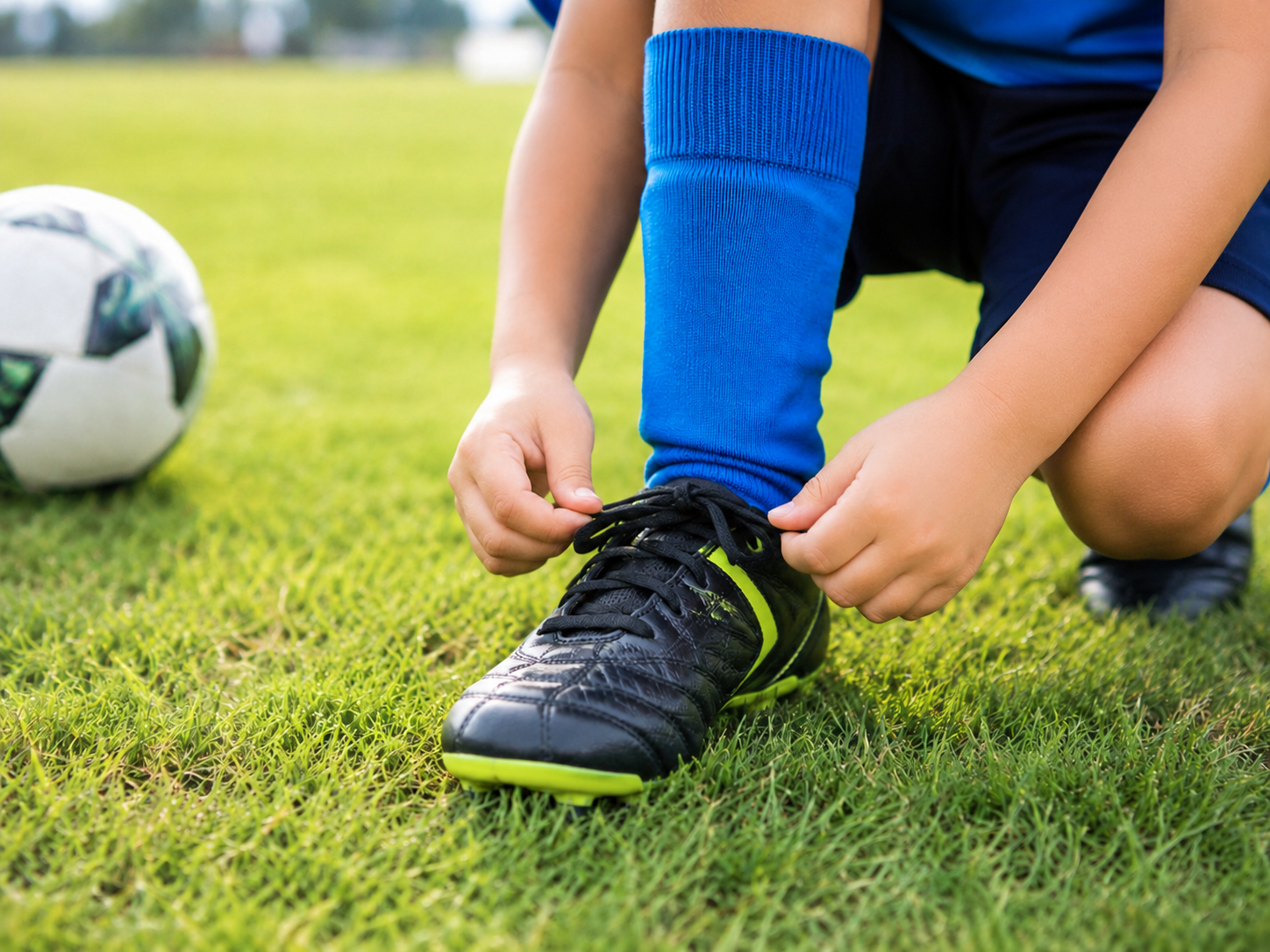
- About a thumb’s width of space (roughly 1cm) between the longest toe and the end of the boot. The Australian Podiatry Association recommends leaving around a centimetre of growing room so toes can move freely and are not squashed from the top or the sides.
- Snug through the middle and the heel, with no slipping up and down at the back when they walk.
- Room to wiggle the toes, but not so much that the foot slides forward.
- Wide enough that the sides of the foot are not pinched. Width matters as much as length.
A few practical tips that make fitting easier:
- Fit boots with the socks they will actually play in. Shin-pad sleeves and thicker sports socks change the fit.
- Try them on late in the day. Feet swell slightly as the day goes on, so an afternoon fitting gives you a truer size.
- Get them to stand and move, ideally a little jog or a couple of quick stops. Boots can feel fine sitting down and pinch the moment a child runs.
So how tight should soccer boots be? Snug, not tight. Boots do give a little as they break in, but they should feel comfortable from the first wear. If your child is scrunching their toes or peeling the boots off the second they get in the car, they are too small.
What size to buy, and when to size up
The big temptation is to buy a size or two too big so the boots “last the season.” Resist it. A boot that is too big is a real problem: the foot slides around, which causes blisters, kills the grip the studs are meant to provide, and increases the chance of trips and rolled ankles. Podiatrists are clear that too much length is as much of an issue as too little.
That said, kids’ feet grow fast, and you do want a little growing room. Here is roughly what you are working with, according to podiatry growth data:
- Preschoolers (3 to 5 years): feet grow around a quarter to half a size every four to six months.
- School age (5 to 9 years): a quarter to half a size roughly every six months.
In practice that means most kids go up about half a size a year, sometimes more during a growth spurt. The thumb’s width of room is your buffer, and it is enough. You do not need to add extra on top of it.
How to check size at home between fittings:
- Trace around your child’s foot on paper while they are standing (standing spreads the foot to its true size).
- Measure from heel to longest toe.
- Compare against the brand’s size chart. Soccer boot sizing varies between brands and between AU/UK, US and EU scales, so always check the specific chart rather than assuming your child is “a size 12” across the board.
Re-check the fit every few months, not just once a season. A boot fitted in autumn is very often too small by spring.
Ground types explained: what FG, AG, SG, HG and MG mean
This is the part that trips most parents up, and it is genuinely worth understanding, because the letters on the box tell you exactly what surface the boot is built for.
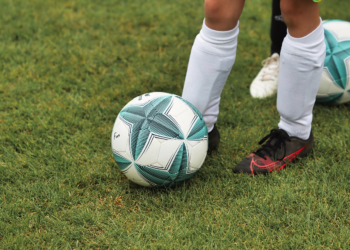
- FG (Firm Ground): the default, and the one most kids want. Moulded studs designed for natural grass that is not waterlogged. For most Australian junior soccer played on grass, FG is the right call.
- AG (Artificial Ground): for synthetic and artificial turf pitches. More studs, shorter and spread out to handle the harder, denser surface. If your child plays on turf, these are worth it.
- SG (Soft Ground): for wet, muddy fields, usually with fewer, longer, sometimes removable metal studs. Rarely needed for junior soccer in most parts of Australia, and often not allowed at junior level.
- HG (Hard Ground): for dry, sun-baked pitches (which plenty of Australian grounds become by mid-season). Shorter, more numerous studs than FG.
- MG (Multi Ground): a hybrid stud pattern meant to cope with a range of surfaces. A reasonable “one boot for everything” option if your child plays across different grounds.
For the vast majority of kids playing on grass, firm ground (FG) boots are the answer. If you are unsure, FG is the safe default. If they are on artificial turf most weeks, look at AG.
Studs: moulded, metal, or none?
Once you have the ground type sorted, the stud question mostly answers itself. But two things are worth spelling out.
Moulded studs (plastic or rubber, fixed to the sole) are what you want for junior soccer. They are safe, low-maintenance and suited to firm and hard grass grounds. This is what the overwhelming majority of kids should be wearing.
Metal studs (usually screw-in, on soft-ground boots) are not appropriate for junior players. Most junior competitions in Australia ban them outright on safety grounds, and they are overkill for the conditions kids actually play in. If you are looking at soccer boots with metal studs for a young child, you almost certainly do not need them.
No studs at all means indoor or futsal shoes, with a flat rubber sole for hard courts. Different surface, different shoe.
Soccer boots vs footy boots: are AFL and soccer boots the same?
This one comes up a lot in Australian households juggling more than one code, so it is worth a clear answer.
Soccer boots and football (AFL) boots are similar but not identical. The key difference is the toe: AFL boots usually have an extra stud right at the front (a toe stud) to help with kicking and marking, while soccer boots leave the toe area clear because soccer players strike the ball with the side and top of the foot. Soccer boots also tend to be lower-cut and lighter.
Can you share a pair across codes for a young kid who does a bit of both? At the youngest ages, on grass, often yes: a firm-ground boot without a toe stud will do for casual play in either. But once kids are playing organised AFL, the toe stud genuinely helps, and some junior competitions have their own footwear rules. For soccer specifically, a soccer boot with no toe stud is the correct choice.
A quick age-by-age guide
- 2.5 to 5 years (Minis and Preschool age): runners or flat, flexible shoes are fine. If you do buy boots, prioritise softness, flexibility and easy fastening (velcro over laces at this age). Comfort and confidence matter far more than performance.
- 5 to 8 years (Junior age): a proper pair of lightweight FG boots makes sense as games get more active. Moulded studs, snug fit, velcro or easy laces.
- 8 to 11 years (Premier age): kids can handle laced boots and start to have opinions (colour, brand, their favourite player’s model). Keep steering the decision back to fit and ground type, and let them enjoy the fun part.
How often will you be replacing them?
Realistically, plan for a new pair roughly every six to twelve months, driven by two things: growth and wear.
- Growth: as above, expect around half a size a year, faster during spurts. Check the fit every few months.
- Wear: kids are hard on boots. Watch for worn-down studs, a sole separating from the upper, or the toe wearing through. A boot that still fits but is falling apart has lost the grip and support it is meant to provide.
Whichever comes first, growth or wear, is your signal. Plenty of families get a full season out of a pair; some fast-growing kids need a mid-season swap.
Make them last: quick care tips
- Knock off mud after each game and let them air dry. Never dry boots on a heater or in direct sun, which cracks the material.
- Do not put them through the washing machine. Wipe them down by hand with a damp cloth.
- Loosen the laces and pull boots off properly rather than stomping the heel down, which breaks the back of the boot.
- Store them somewhere ventilated, not scrunched at the bottom of a wet sports bag.
See a session in action
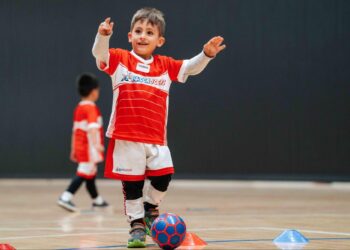
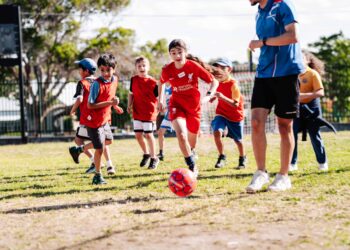
Not sure what your child will actually be doing in those new boots? Here is a quick look at a Soccajoeys class, and why it is built around fun and confidence rather than competition.
The bottom line
Choosing soccer boots for kids comes down to a short checklist: get the fit right first (thumb’s width of room, snug heel, comfortable from day one), match the ground type to where they play (FG for most grass, AG for turf), skip the metal studs, and re-check the size every few months as their feet grow.
Everything else, the colour, the brand, the pro player on the box, is a bonus. A child who loves their boots and can run freely in them is exactly where you want to be. The right boots simply make it easier for them to build real ball and movement skills and enjoy all the benefits soccer offers growing kids.
And once they are kitted out, they need somewhere to use them. Soccajoeys runs structured, age-appropriate soccer programs for children aged 2.5 to 11 across Australia, with trained coaches and a focus on fun, confidence and skills. Find your nearest program and let those new boots earn their keep.