


Simple, real-food snacks that actually fuel busy, sporty kids — without hours in the kitchen.
If you have an active child, you know the sound. The back door swings open, the bag hits the floor, and before they have even taken their shoes off: “I’m STARVING.” It happens after school, after a Soccajoeys session, after ten minutes tearing around the backyard. Active kids burn through energy fast, and snacks are how they top the tank back up.
The trouble is that “snack” has quietly become shorthand for a wrapper: something beige, sweet and gone in thirty seconds that leaves them hungry again before dinner. It does not have to be that way, and getting it right does not mean hours in the kitchen either.
This is a practical guide to healthy snacks for kids who move a lot. What to actually put in the lunchbox, what to have ready for the after-school raid, what to feed them around a game, and how to keep it all realistic on a busy week.
Why active kids need good snacks (not just treats)
Here is the bit worth understanding: for kids, snacks are not an indulgence, they are mini-meals. Children have small stomachs and high energy needs, so they genuinely cannot get everything they need from three meals a day. Snacks bridge the gap and keep energy and concentration steady in between.
Australian guidance for children is built around exactly this idea: regular meals and snacks across the day help kids maintain energy and get variety across the food groups, and the advice is to include a few different food groups at every meal and snack. For a child who is running, kicking and turning at sport a couple of times a week on top of everyday play, that steady supply of good fuel matters even more. It is one of the quiet benefits of an active childhood: hungry, well-fed, well-moved kids tend to sleep and concentrate better too.
A snack that is all quick sugar (a lolly, a sweet drink, a plain sweet biscuit) gives a fast spike and an equally fast crash, often with a mood dip and an “I’m hungry again” fifteen minutes later. A snack with a bit more substance keeps them going.
The simple formula for a snack that actually keeps them full
You do not need to overthink this. A snack that holds a child over usually combines two or three of these:
- A carbohydrate for quick energy: fruit, wholegrain crackers, bread, oats.
- A protein or healthy fat for staying power: cheese, yoghurt, eggs, nut or seed butter, hummus.
- Something colourful: a piece of fruit or some veggie sticks.
So instead of crackers alone, it is crackers with cheese. Instead of plain toast, it is toast with peanut butter and banana. Instead of just an apple, apple slices with a tub of yoghurt. Pairing a carb with a protein or a fat is the single easiest upgrade you can make, and it is what turns a snack from a sugar hit into actual fuel.
Healthy lunchbox snacks
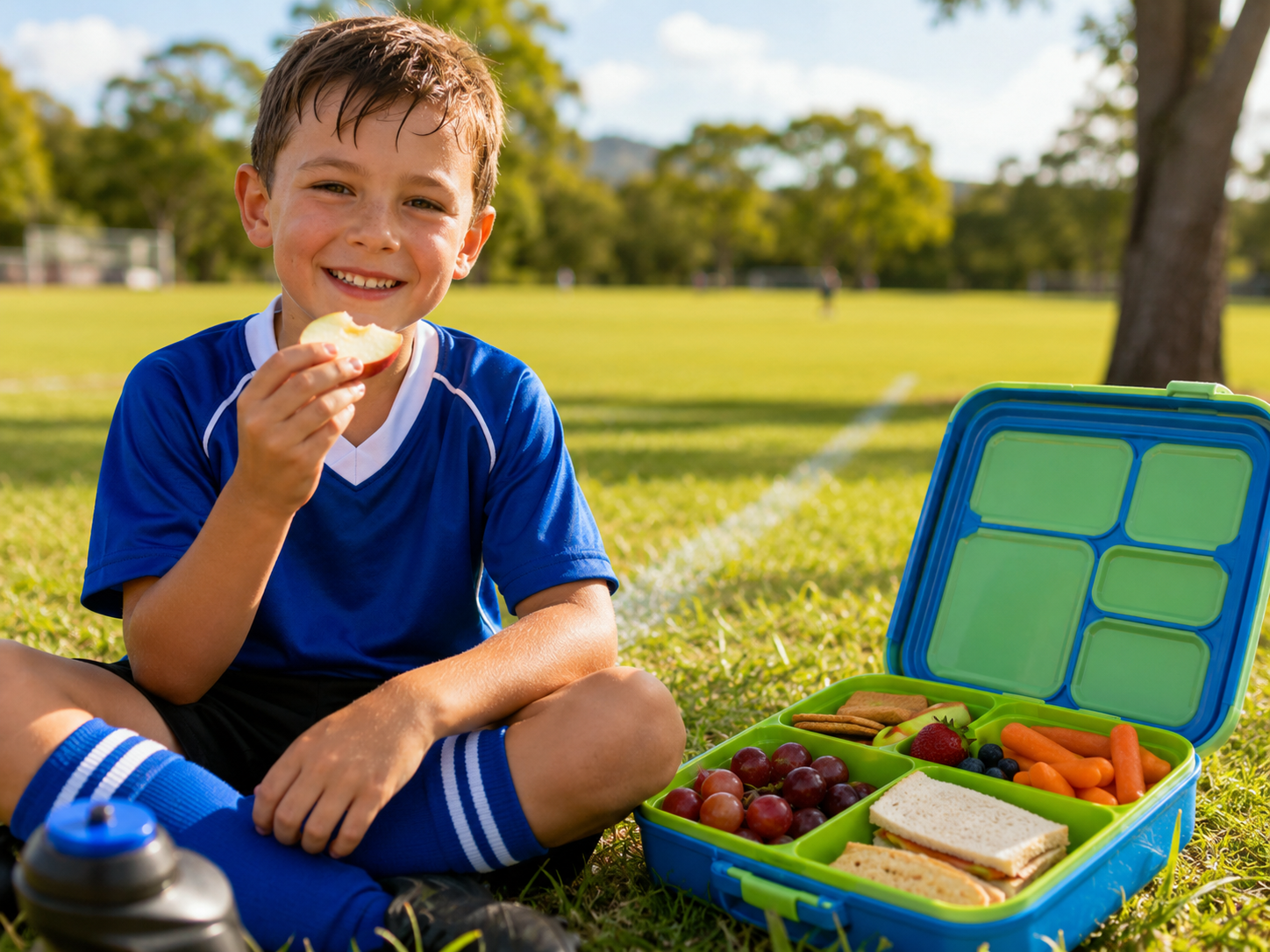
Lunchbox snacks need to survive a few hours in a bag and be easy for small hands to open. Reliable healthy snacks for kids’ lunchboxes include:
- Cheese and wholegrain crackers
- A tub of yoghurt (freeze it overnight in summer and it thaws by recess)
- Veggie sticks (carrot, cucumber, capsicum) with a small tub of hummus
- A piece of fresh fruit, or a small container of berries or grapes (halved for little ones)
- A wholegrain muffin or a slice of homemade banana bread
- A boiled egg
- Air-popped popcorn
- A small container of wholegrain cereal or a few rice cakes
One school rule to plan around: many Australian schools are nut-free, so swap nut butters for a seed butter or cheese in the lunchbox, and save the peanut butter toast for home.
After-school snacks for the 4pm raid
The after-school window is when kids are hungriest and most tired, and it is close enough to dinner that you do not want to fill them right up. Aim for something quick and satisfying that takes the edge off:
- Toast with avocado, or nut butter and banana
- Greek yoghurt with fruit and a sprinkle of oats
- Apple or pear slices with cheese
- A wholegrain wrap with cheese and grated carrot
- Veggie sticks and hummus
- A smoothie: milk or yoghurt, a frozen banana, a handful of berries
Keep a few of these ready to grab. A container of pre-cut veggies or washed fruit sitting at kid-height in the fridge does more for healthy after-school snacking than any amount of good intentions.
Snacks around a game or training
This is where “active kids” really comes in, and timing matters as much as the food itself.
Before a game or Soccajoeys session (roughly one to two hours out), go for easy, familiar carbs that sit lightly in the stomach: a banana, a piece of toast, a small tub of yoghurt, a few crackers. This is not the moment for anything heavy, greasy or brand new. We break the timing down properly in our guide on what to eat before a soccer match.
After a game, kids are refuelling and recovering, so a carb-plus-protein combo is ideal: a wrap, cheese and crackers, yoghurt and fruit, or a sandwich if dinner is still a while away.
And whatever the occasion, the drink is water. More on that next.
Don’t forget hydration
Snacks and drinks go together, and this is the easy win parents most often miss. Water is the best drink for children, full stop. It is worth being clear that sports drinks and energy drinks are not made for kids and are not needed for junior sport, however good the ads look. For a Saturday-morning soccer game, water is genuinely all your child needs.
A few hydrating foods help too: watermelon, oranges, cucumber and tomatoes are almost all water and double as a snack on a hot day.
Everyday foods vs sometimes foods (and why guilt is not on the menu)
It helps to borrow the language the Australian Guide to Healthy Eating uses. There are everyday foods (the five food groups: fruit, veg, grains, dairy and protein) and there are sometimes foods (the sweet, packaged, treat-type things). The goal is not to ban anything or turn every snack into a negotiation. It is simply to make everyday foods the default, and keep sometimes foods for, well, sometimes.
A biscuit at a party, an ice cream after the game on a hot day, a slice of birthday cake: all completely fine, and part of a happy childhood. Balance across the week matters far more than any single snack, and kids who grow up without food being a battleground tend to build the healthiest relationship with it.
Easy homemade snacks (that don’t take all afternoon)
If you want a couple of make-ahead options, these two cover most bases and freeze well.
- Oat and banana bites (no bake): mash 2 ripe bananas, stir through 1.5 cups of rolled oats and a handful of sultanas (or choc chips for a treat version), roll into balls and refrigerate. Ten minutes, no oven.
- Simple veggie muffins: grated zucchini and carrot, grated cheese, a couple of eggs and self-raising flour, baked in a muffin tin. Great in the lunchbox, and a quiet way to get some veg in.
Batch-make on a Sunday, freeze, and pull them out through the week. Homemade snacks give you the most control over added sugar, and kids love helping make them.
Quick answers to common questions
How many snacks a day do kids need?
Most children do well with two to three snacks a day between meals, though active or younger kids may need a little more. Follow their hunger rather than the clock.
Are muesli bars a healthy snack?
Some are, many are not. Plenty of supermarket bars sit closer to sometimes foods than everyday ones. Look for whole ingredients (oats, nuts, seeds, fruit) and less added sugar, or make your own.
What is the best snack before sport?
Something light and carb-based that your child already likes and digests easily. A banana or a piece of toast an hour or so beforehand is hard to beat.
What about fussy eaters?
Keep offering variety without pressure, eat the same foods yourself, and involve them in choosing and making snacks. Exposure and role-modelling do the heavy lifting over time. If you have ongoing concerns about your child’s eating, a GP or dietitian is the right person to ask.
See a session in action
Wondering what your well-fuelled kid actually gets up to? Here is a quick look at a Soccajoeys class, and the kind of energetic, non-competitive play that works up a proper appetite.
The bottom line
Healthy snacks for active kids do not need to be complicated, expensive or Instagram-worthy. Pair a carb with a protein or a healthy fat, add something colourful, keep water on hand, and have a few easy options ready to grab. Get that right most of the time, and the occasional treat looks after itself.
The other half of the equation is the running around itself. Well-fuelled kids need somewhere to burn all that energy, and that is exactly what we do. Soccajoeys runs fun, structured soccer programs for children aged 2.5 to 11 across Australia, building confidence, coordination and a love of being active. Find your nearest program and let them work up a proper appetite.
For more ideas, browse our nutrition tips for active kids.